Where to See Alpacas and Llamas in Israel: Alpaca Farm in Mitzpe Ramon, and How a Place Was Built Around a Herd
If you are wondering where to see alpacas and llamas in Israel, the answer is in the Negev highlands, in Mitzpe Ramon: Alpaca Farm, a small family farm that has raised alpacas for their wool since 1987. Around that herd today stand a wool factory, an amphitheater, a stone cabin, cabins and suites on the hillside, a village of yurts and a retreat centre. We invite you to slow down and read how it all came to be, because here the buildings follow the animals, and not the other way round.
Where to see alpacas and llamas in Israel: a farm that began with a herd
Alpaca Farm was founded by Ilan and Naama Dvir, and it has raised alpacas for wool since 1987, which is close to forty years of work with the same kind of animal. The alpacas and llamas were brought to Israel from the Andes in South America, a long way from the Negev. The farm has stayed small and family-run, with a personal touch, and more than a million and a half visitors have walked through its gate.
Alpacas and llamas are cousins from the camel family and share a common ancestor. For generations llamas worked as pack animals, carrying loads along mountain ridges. Alpacas became known for a soft, luxurious fleece, and as far back as the Inca period special cloth was woven from it. That difference, between the animal that carries and the animal that gives wool, is part of what visitors are taught here before they ever hold out a hand.
From shearing to sweater: what the wool needed built
A herd raised for wool needs places for everything that comes after the shearing, which happens every year as spring arrives. So the farm has a wool factory, a wool house and a shop. It is one of the few places where you can follow the whole production process in a single spot, from the alpaca to the sweater, and it is described as the only boutique farm outside the Americas where every stage takes place under one roof.
Guided tours run at every full hour and include a visit to the factory where the wool is processed and made. The wool is never dyed. It comes in four base colours and 32 natural in-between shades, all of them from the animals themselves. It weighs about half as much as sheep’s wool and suits sensitive skin, babies included, since it holds little lanolin and no dander. On days when the farm is open, the shop sells scarves, hats, gloves and socks.
If you would rather touch the wool than only look at it, you can try felting, dry or wet, at any point in the day. The wool-craft activities cost extra, they suit all ages, and children under 8 need an adult beside them. Places are limited, so tickets should be booked in advance.
The amphitheater and the stone cabin: places to sit and listen
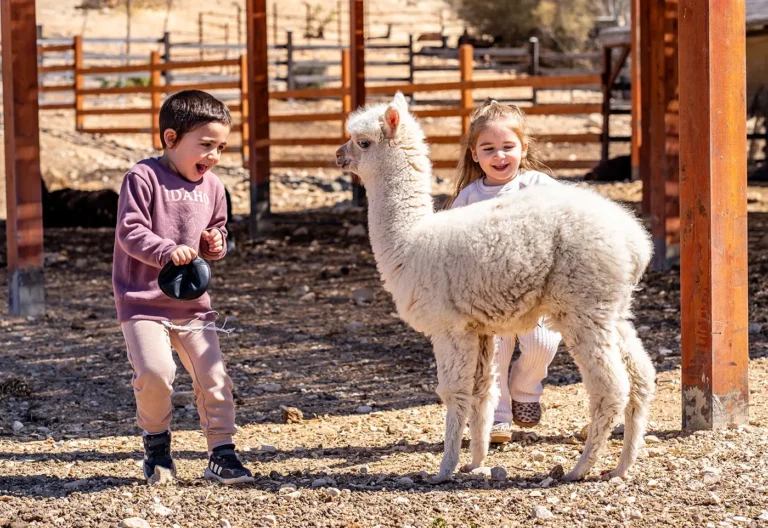
The farm has an amphitheater where its story is told. Visitors hear how the place began, learn the differences between alpacas and llamas, and then go out to feed them from the palm of the hand. Every visitor receives a feed bag as part of the entrance ticket. The farm is home to about 250 animals: alpacas, llamas, goats, horses, donkeys, dogs, ducks and a camel.
Afterwards there is a stone cabin where you can rest with a drink and an ice cream. There are several shaded seating corners, with tables inside the cabin and two shaded pergolas. You may bring food from home and sit at any of them. The place describes itself as authentic, with soul, animals and real nature, and not as somewhere designed for Instagram.
On the hillside: cabins, suites and yurts
The cabins stand on the slope of the mountain and look out over the farm. The Alpaca and Llama zimmers are 29 square metres with a 14 square metre balcony. The Raz and Yael suites are 44 to 50 square metres with a large balcony, and they sleep up to six guests in Raz and up to nine in Yael. Air conditioning serves both heating and cooling in every unit.
The yurt village has ten Mongolian yurts of about 30 square metres each, every one for up to five people. Each has a private toilet and sink, made-up beds, air conditioning and heating, warm lighting and a pergola with a private seating corner at the entrance. Hammocks hang outside, and the yurts look out toward Ramon Crater. Towels are supplied in the zimmers and yurts.
Check-in is between 15:00 and 19:00 and check-out is by 11:00. On weekends and holidays the minimum booking is two nights. The farm does not serve meals, but every kitchen has a fridge and the equipment to cook for yourselves.
The dome and the studio: rooms built for stillness
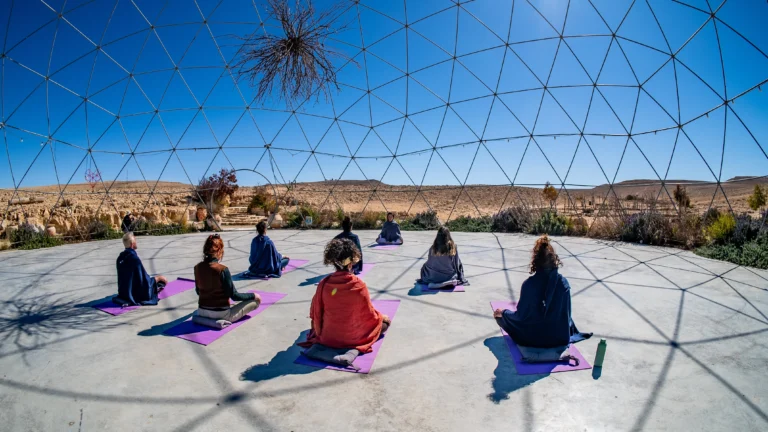
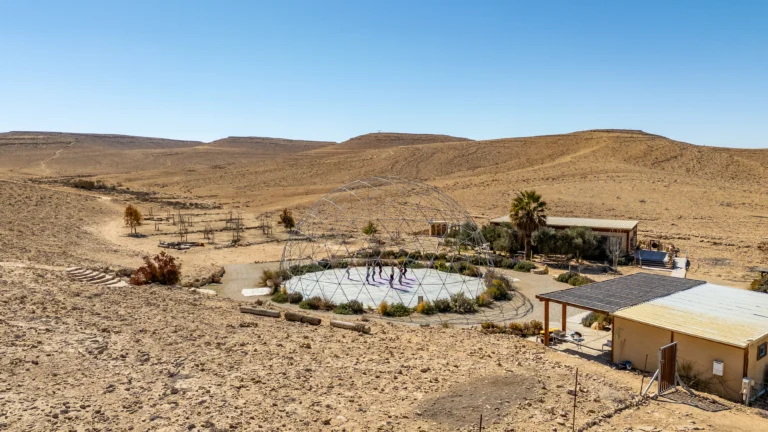
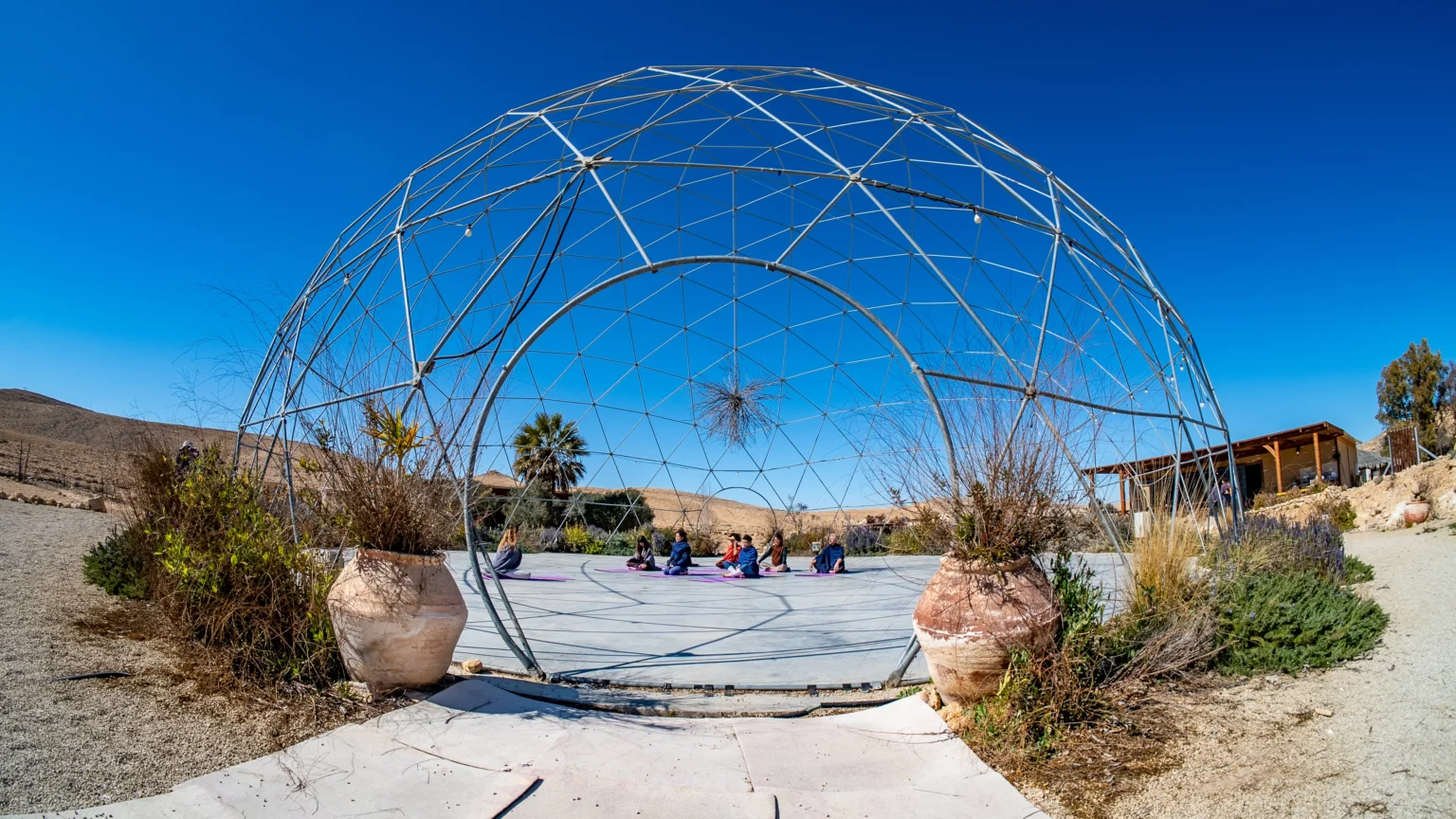
The farm also runs a retreat centre. At the heart of the complex stands a geodesic dome, a space for gathering and movement, and beside it a studio of 80 square metres with a wooden floor. The dome can sleep groups of up to 14 on thick 10 cm mattresses, with no sheets, blankets or towels, and the studio sleeps groups of up to 20. Retreats and groups of 20 to 45 participants are welcome, and the alpacas and llamas are part of the retreat experience. For retreats and workshops, call 051-2998460 or write to [email protected].
Beyond the gate: the crater, the ammonites and dark skies
Ramon Crater is about seven minutes’ drive away. It is the largest of the Negev craters and an international dark-sky reserve, the first in the Middle East. The Ammonite Wall is about 15 minutes away and the Minsara a quarter of an hour. Several easy walking trails also leave from the farm toward viewpoints.
Before you come: days, hours and what to know
The farm is open Thursday to Saturday from 09:00 to 18:00 and on Sunday from 09:00 to 16:30. During school holidays it opens every day, and from 01.08.26 it is open daily from 09:00 to 18:00. On winter time it closes at 16:30, and the last entry is half an hour before closing. You do not need to arrange a visit in advance unless your group is larger than 30 people. For general questions call 08-658-8047 or write to [email protected].
Frequently asked questions
Where can I see alpacas and llamas in Israel?
Alpaca Farm in Mitzpe Ramon, in the Negev highlands, is home to alpacas and llamas, and has raised alpacas for wool since 1987. You can feed them from your palm, join a guided tour and visit the wool factory. In all, about 250 animals live on the farm.
Do we need to book before visiting Alpaca Farm?
You do not need to arrange an ordinary visit in advance, except for groups of more than 30 people. Places in the activities are limited, though, and tickets should be booked ahead. That applies to the felting workshops, which cost extra.
Can children ride the alpacas or llamas?
No. The public cannot ride the animals at Alpaca Farm, and the llamas on the llama picnic cannot be ridden either. Sensitive-riding workshops are held only for groups arranged in advance, and horse riding is available by prior arrangement.
Can we bring our dog to Alpaca Farm in Mitzpe Ramon?
No dogs or other animals may enter the farm. If you need to bring a service dog, contact the farm office to arrange it.
Can we stay overnight at Alpaca Farm?
Yes. The farm has air-conditioned Mongolian yurts, zimmers and suites on the hillside. Check-in is between 15:00 and 19:00 and check-out is by 11:00. On weekends and holidays the minimum booking is two nights.
Is the farm accessible for wheelchairs and strollers?
Yes, the farm is accessible to wheelchairs and strollers. It is also a place that suits young children, with activities that are safe for the very young.
How do we get to the farm without a car?
No public transport reaches the farm. You can walk from Mitzpe Ramon or take a taxi.
Is there a guided tour in English?
English guiding is not regular, but it can be arranged in advance on request. The signs around the farm are in both Hebrew and English.
Do young children pay, and are there discounts?
Children under 2 enter free, and the entrance fee applies from age 2. There are discounts for soldiers, security forces, retirees, people with disabilities and students.