Feeding Alpacas and Llamas by Hand in Mitzpe Ramon, and What Else Is Eaten at Alpaca Farm
An open palm and a bag of feed
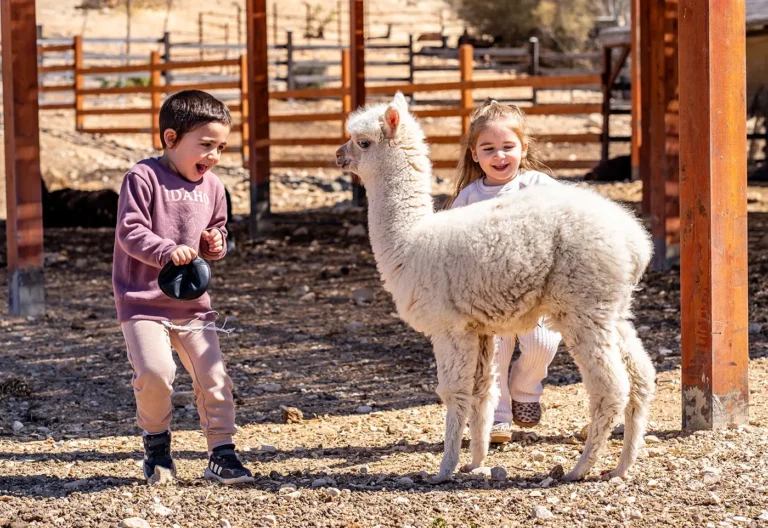
Feeding alpacas and llamas by hand in Mitzpe Ramon is the first meal served at Alpaca Farm, and it happens before any of you has sat down to anything. The farm stands in the Negev Highlands, in Mitzpe Ramon, and every visitor receives a feeding bag as part of the entry ticket, so the meal is already in your hand when you walk in.
The idea is simple, and it asks you to slow down. You hold out a flat palm, you wait, and the animal comes to you. At Alpaca Farm the alpacas, llamas, horses and the rest of the herd can all be fed from the hand, and there is no rush to get it done. Children can feed the alpacas, stroke them, take a selfie with them, and the farm says they are even welcome to give them a kiss. If one bag runs out before the visit does, extra bags cost 5 ₪.
The petting corner is natural, not industrial, and the farm describes itself as a small family place that keeps things personal: real animals, real desert, and a place that was never designed for a photograph. It is the kind of feeding where you stay for another round because the animals are still interested.
About 250 mouths at the fence
The farm is home to roughly 250 animals: alpacas, llamas, goats, horses, donkeys, dogs, ducks and a camel. The alpacas and llamas are the reason most people come, and they are closer relatives than they look. They are cousins from the camel family and share a common ancestor. Llamas were bred for generations as pack animals that carried loads along mountain ridges, while alpacas are known for their soft, valuable fleece, which the Inca were already weaving into special fabrics.
The herd came to Israel from the Andes in South America, and the farm has raised alpacas for their wool since 1987, almost forty years. During a visit you receive a talk on the story of the farm and learn the differences between alpacas and llamas, so by the time you hold out your hand you can tell who is who. Guided tours start at every round hour.
Something cold, something hot, and a stone cabin
After the animals have eaten, it is your turn. The farm sells soft drinks, hot drinks and popsicles, and the stone cabin is a place to rest with a drink or an ice cream while the heat of the day passes. There are several shaded seating corners around the grounds, and the cabin has tables in an enclosed space plus two shaded pergolas.
You are also welcome to bring your own food from home and sit down at any of those seating corners. For a family with small children this makes the visit easy to shape: feed the animals, open the sandwiches, let everyone sit for a while. The farm also has a coffee and tea corner with fresh tea herbs from its own garden.
If you stay the night: a kitchen of your own
It is worth knowing in advance that the farm does not serve meals, breakfast included. What it offers instead is a kitchen you cook in yourselves, and that suits the place well: you buy what you like, you cook at your own pace, and you eat on a terrace facing the desert. Every kitchen has a home-size fridge, along with cooking utensils and tableware.
In the chalets and suites the kitchenette is equipped with a fridge, a Nespresso machine, an electric hob, an oven and dishes. At the yurt compound there is a large equipped kitchen that allows self-catering for individuals or for groups of up to 50 people. Kashrut is not observed in the kitchens, which matters for anyone who keeps it.
There are no barbecues at the farm and no grilling meat over open flames in the shared areas. Fire is kept for the private fire areas and the fire corners at the yurt compound, where the evening can end the way it should, with people sitting around flames and nothing else to do.
Wine, cheese and a fire after dark
For the evening the farm offers a boutique wine and cheese night: local boutique cheeses, Israeli boutique wines and a campfire. It suits couples, families and workshop groups, and it fits well with another evening activity at the farm, guided stargazing with professional telescopes and explanations of what is overhead.
Mitzpe Ramon is also the setting that makes the evening work. The Ramon Crater, about seven minutes away by car, is an international dark sky reserve, the first in the Middle East, so the sky above the table is exactly as dark as you hope it will be.
A llama picnic: bring the groceries
One activity deserves a clear warning, because it is about food. The llama picnic must be arranged in advance with the farm office, and the farm does not supply food for it, so you bring the groceries yourselves. Riding the llamas is not possible, and that is part of what the picnic is: you sit together, you eat, and the llama is a companion rather than transport.
The office takes bookings for accommodation, groups and alpaca picnics every day, by prior arrangement. For general details you can call 08-658-8047 or write to [email protected].
After the feeding: the wool, the trails and the crater
A visit to the farm does not end with the feeding bag. The guided tours include a visit to the wool factory, and the farm is one of the few places where you can see the whole process in one place, from the alpaca to the sweater. The wool shop sells scarves, hats, gloves and socks on days of activity.
Several easy walking trails leave from the farm toward viewpoints, and the Ramon Crater is about seven minutes away by car. If you are staying the night, walking out at sunset is a quiet way to let the day settle before you light the stove.
Frequently asked questions
Is the feeding bag included in the ticket at Alpaca Farm in Mitzpe Ramon?
Yes. Every visitor to Alpaca Farm in Mitzpe Ramon receives a feeding bag as part of the entry ticket. If you want to feed more, extra bags can be bought for 5 ₪.
Which animals can I feed by hand?
The alpacas, llamas, horses and more can be fed from the palm of your hand. The farm is home to about 250 animals, including goats, donkeys, ducks and a camel. Children can feed and pet the alpacas and take a selfie with them.
Can we bring our own food and eat at the farm?
Yes. You can bring food from home and sit at any of the shaded seating corners, and the farm sells soft drinks, hot drinks and popsicles. There is also a stone cabin where you can rest with a drink or an ice cream. Barbecues are not allowed anywhere on the farm.
Are meals or breakfast served for overnight guests?
No, there is no meal service at the farm, breakfast included. The accommodation has equipped kitchens for self-catering, each with a home-size fridge and cooking utensils. Kashrut is not observed in the kitchens.
Does the llama picnic include food, and can we ride the llamas?
The farm does not provide food for the llama picnic, so you need to bring your own groceries. The activity must be arranged in advance with the farm office, and the llamas cannot be ridden.
What days and hours is Alpaca Farm open?
The farm is open Thursday, Friday and Saturday from 09:00 to 18:00, and on Sunday from 09:00 to 16:30. In school holidays it is open every day. Last entry is half an hour before closing, and in winter time the farm closes at 16:30.
Can I bring my dog to the farm?
No, dogs and other animals cannot enter the farm. For a service dog, contact the farm office to arrange entry.
Is the farm suitable for strollers and wheelchairs?
Yes, the farm is accessible to wheelchairs and strollers. Children under 2 enter free, and entry is paid from age 2.
Is the animals’ food kosher for Passover?
During the Passover holiday the food given to the animals at the farm is kosher for Passover.